

HSiPaaS - Human System Integration Platform as a Service
Also on Substack (in Portuguese)
Topics
AI's hyperfocus and why humans became the ultimate interface
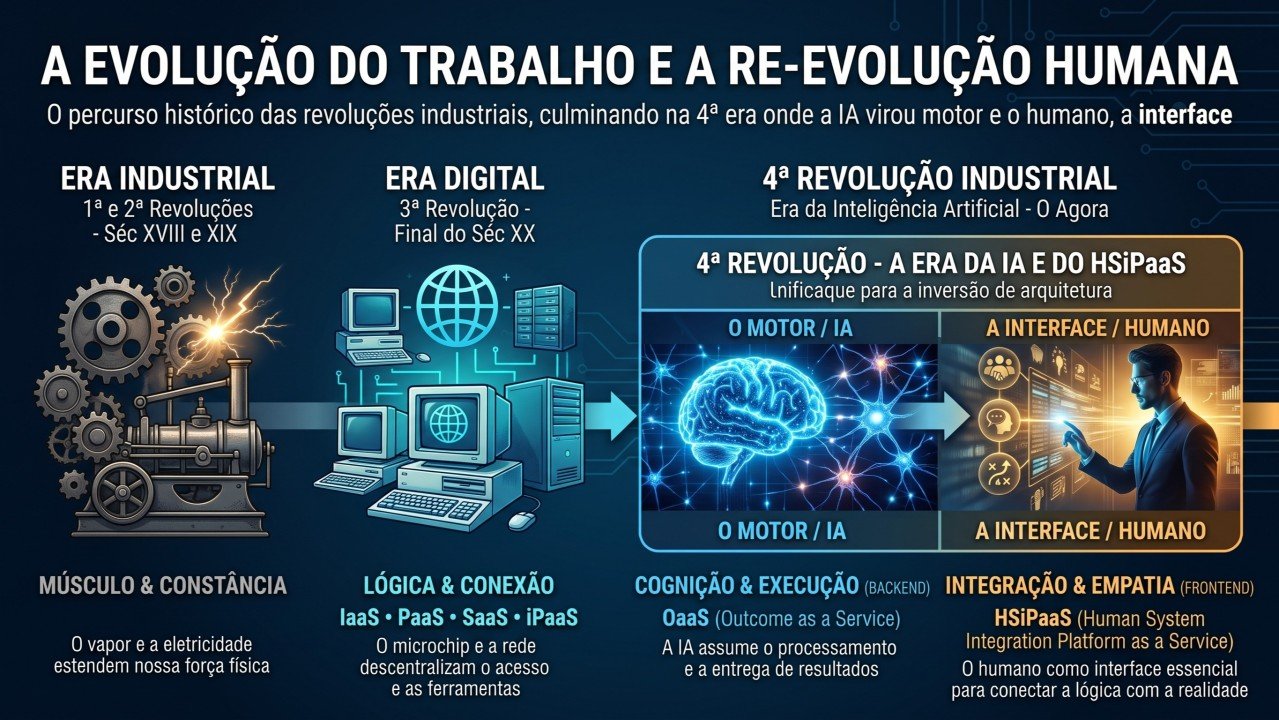
Gather round, it's story time: the first industrial revolution gave us steam to extend our strength. The second brought electricity to automate our consistency. The third gave us software to scale our logic. Now, in the fourth revolution, AI flips the architecture: it takes over the core of the engine, and we become the interface. (a personal take from yours truly, the Product Designer).
Tech's alphabet soup has always tried to capture where the value of our work lies. We started by renting infrastructure (IaaS), moved on to platforms (PaaS) and, over the last decade, watched SaaS (Software as a Service) take over the world by selling tools. The premise was to build a system and sell a license so that another human could run that digital machinery.
The early promise of generative AI was to get rid of even that operator, ushering in a future of autonomous agents solving everything on their own. But the real market, as usual, sent the bill.
As the honorable mano deyvin pointed out recently (https://youtu.be/8Vk059HpH0s, in Portuguese), building tools has become a commodity. Today an AI spits out a complex system in seconds. The direct consequence is that the big investment funds have realized that selling access to software is no longer enough.
The market had to pivot to OaaS (Outcome as a Service). Instead of selling the HR system, the company delivers the interviewed candidate. Instead of selling the accounting software, it delivers the books already done. Deep down, this is good old service work repackaged: consulting with a gourmet label. Even giants like Anthropic are investing millions to train humans to run these tools inside companies.
So why does the promise of 100% autonomous AI seem to be failing, and calling humans back in to make OaaS work?
A respectful analogy helps here: Artificial Intelligence works a lot like a neurodivergent mind with an extraordinary degree of hyperfocus.
It has a magnificent ability to cross-reference data, spot invisible patterns and carry out tasks at formidable speed. But, much like a challenge faced in some conditions on the spectrum, it has a really hard time with what goes unsaid.
AI can't "read the room". It doesn't get irony, can't navigate office politics and doesn't understand the unwritten rules of human relationships. As Deyvin aptly put it, AI can't handle the "client from hell". It doesn't realize that when a director asks for "a super interactive AI dashboard", what they actually need is just a one-page PDF summary on Friday afternoon. It's a genius at raw processing, but blind to the chaotic subjectivity of the corporate world.
And this is where worlds collide. On one side, we have AI's logical, hyperfocused engine. On the other, the dear client, full of subjectivity and unspoken rules.
In classic engineering, what connects ecosystems that don't speak the same language is iPaaS (Integration Platform as a Service). But in this new corporate architecture, to connect silicon with human emotion, I'm going to use some poetic license and go one level deeper into the alphabet soup.
Allow me to introduce our new role: HSiPaaS - Human System Integration Platform as a Service.
We are the HSiPaaS! We are the ultimate human-system integration platform.
Any professional today, from the accountant to the developer, from the recruiter to the strategist, is the one running the ETL (Extract, Transform, Load) of the client's desperation into the machine's prompt, and then taking AI's raw output and wrapping it in empathy, context and accountability before handing it back to the real world.
In this new dynamic, AI is our backend. But we are the frontend: the social intelligence, the smile in the meeting and, above all, the name on the line who signs off and takes responsibility.
All that fearmongering about AI replacing us entirely stops making sense when we look at history: since the first revolution, technology has existed to absorb mechanical effort, freeing our energy for what makes us fundamentally human: strategy, empathy and connection.
The revolution didn't make us obsolete. It just took us off the assembly line and put us on the front line.